
How to Find Your Property Lines and the Pins That Mark Them
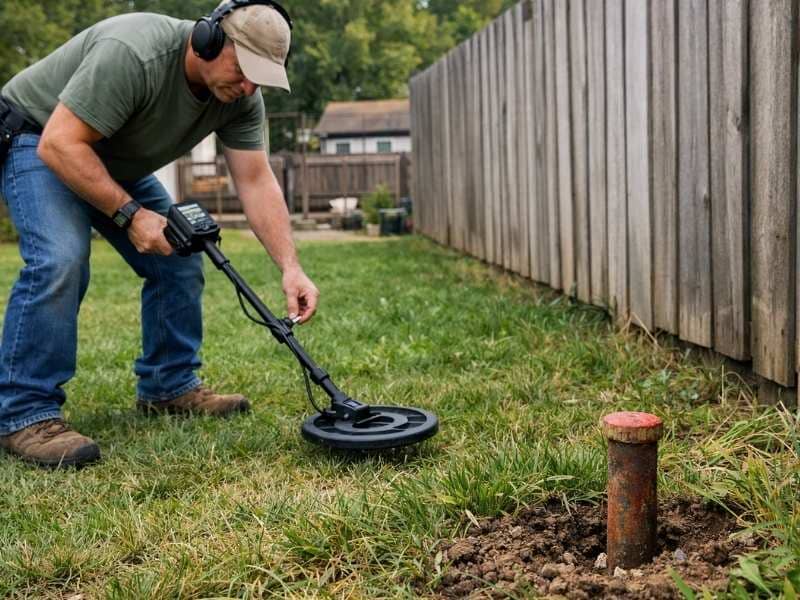
To find your property lines, start with your survey plat or your county’s online parcel map. Then use those measurements to locate the property pins, which are metal markers buried at each corner of your lot. A metal detector helps you find pins hidden underground. Always call 811 before you dig, and hire a licensed surveyor when you need legal certainty.
Maybe you want to put up a fence. Maybe a neighbor disagrees about where your yard ends. Or maybe you just want to know exactly where your land begins and ends. Whatever the reason, finding your property lines is one of the most common questions homeowners ask. The good news is that you can often do it yourself in an afternoon using free public records and a few simple tools. This guide walks you through each method, from the quickest to the most accurate, and shows you when it pays to call a professional.
What Are Property Pins?
Property pins are metal markers, usually iron or steel rods about half an inch thick and 2 to 3 feet long. A licensed surveyor drives them into the ground at each corner of your property to mark its legal boundaries.
Property pins go by many names. You might hear them called survey pins, survey markers, survey stakes, or boundary monuments. They are the real-world points that match the corners drawn on your survey plat. Older pins are often plain metal pipes or rods with nothing on top. Newer pins usually have a colored plastic or metal cap stamped with the surveyor’s license number.
Pins often sit just below the surface. Over time, though, landscaping and yard work can bury them 6 to 12 inches deep. That is why a metal detector is so handy when you go looking for them.
One rule matters above all others. Never move, remove, or reposition a property pin. These markers carry legal weight, and disturbing one can start a boundary dispute or even lead to legal trouble. If you think a pin has been moved, call a licensed surveyor.
Six Ways to Find Your Property Lines
Below are six reliable methods, listed from the fastest free option to the most legally solid.
1. Check Your Survey Plat
Your survey plat is the most useful document you can have. A licensed surveyor draws it to scale, and it shows your lot’s size, corner locations, and the type of marker placed at each corner. If you got a survey when you bought your home, start there. If you did not, your county recorder, clerk, or assessor’s office keeps plat maps on file, and many are available online.
2. Use Your County’s Online Parcel Map
Most counties now offer a free, interactive map called a GIS parcel viewer. It lays your property boundaries over an aerial photo. Just search your county’s name plus “GIS” or “parcel viewer,” then look up your address. These maps are great for getting a general sense of where your corners sit. Keep in mind that they show estimates, not exact lines, so do not use them to place a fence within inches of a boundary.
3. Read Your Property Deed
Your deed holds the legal description of your land. Many deeds describe the property using directions and distances that start at one corner and trace around the lot. You can follow these clues to map your boundaries. The wording takes some practice to read, but it helps confirm what your plat shows.
4. Find the Pins with a Metal Detector
Once you know your lot’s measurements, use a tape measure to estimate where each corner pin should be. Then sweep a metal detector slowly over that spot and listen for a strong, steady tone. When you get a clear signal, dig gently with a small trowel. Remember, pins often sit 6 to 12 inches down.
Before you dig, call 811. This free national number connects you to local utility companies, who will mark any buried gas, water, or electric lines so you do not hit one by accident. Give them about 48 hours’ notice.
5. Measure from the Road
If you cannot find any pins, you can estimate your front boundary from the road. Find the road’s right-of-way width on your plat or parcel map. Assume the road runs down the middle of it, then measure half that width from the center of the road toward your home. This gives you a rough starting point for the front line.
6. Hire a Licensed Surveyor
Sometimes the do-it-yourself route is not enough. If your pins are missing, your project needs to be exact, or you are in a dispute with a neighbor, a licensed surveyor is your best answer. A surveyor studies the records, measures your land, and sets new permanent markers at each corner.
Tools You Will Need
- Your survey plat, deed, or printed parcel map
- A long tape measure or measuring wheel
- A metal detector, which many hardware stores rent
- A small trowel for careful digging
- Flags or marking paint to mark each pin you find
- The 811 number to call before you dig
Should You Do It Yourself or Hire a Pro?
| Your Situation | Do It Yourself | Hire a Surveyor |
| General curiosity or planning | Good choice | Optional |
| Putting up a fence near the line | Risky | Recommended |
| Building an addition or driveway | Not advised | Required |
| Settling a neighbor dispute | Not advised | Required |
| Legal or closing paperwork | Not valid | Required |
The do-it-yourself methods work well when you just want to get your bearings. But once money, permits, new structures, or a neighbor enter the picture, a professional survey is worth every penny. It costs far less than building in the wrong place.
How Much Does a Property Line Survey Cost?
A professional boundary survey usually costs between $300 and $1,000 or more. The price depends on your lot size, location, the shape of the land, and how much research the surveyor must do.
Finding existing pins on your own costs almost nothing beyond a metal-detector rental. The real expense comes when you hire a surveyor to replace missing markers or create an official boundary survey.
Frequently Asked Questions
Can I find my property lines for free?
Yes. Your county’s online parcel map, your plat, and your deed are all free or low-cost records. They give you a clear general picture, though only a professional survey offers true legal accuracy.
How deep are property pins buried?
Pins often start at or just below ground level. After years of yard work, many end up 6 to 12 inches down, so a metal detector is the best way to find them.
Is it legal to move a property pin?
No. Moving or removing a pin can lead to legal trouble and disputes. If a pin is missing or looks disturbed, contact a licensed surveyor.
What is the difference between a property line and a property pin?
A property line is the legal edge of your land, an invisible line that connects your corners. A property pin is the metal marker a surveyor places at each corner to show where that line sits.